When global jewelry brands, wholesalers, and designers search for a reliable gemstone partner, one question consistently tops the list: Who is the best lab opal stone manufacturer in China?
In the modern fine and demi-fine jewelry market, lab created opals have revolutionized collection design. Whether buyers refer to it as synthetic opal, lab grown opal, man made opal, or lab made opal, this vibrant gemstone offers the breathtaking play-of-color of natural opals without the high cracking risks or erratic mining costs.
However, with thousands of suppliers offering synthetic opal for sale across B2B marketplaces, distinguishing a true factory-direct manufacturer from a middleman is crucial. In this guide, we examine the technical standards of Chinese opal production, compare gemstone grades, and explain why MaxNax Jewellery is the premier manufacturing partner for both loose stones and custom OEM/ODM opal jewelry.
1. Lab Created Opal vs. Gilson Opal vs. Artificial Opal: What B2B Buyers Must Know
Terminology in the gemstone trade can be confusing. When sourcing from China, understanding the exact chemical composition behind different market terms will protect your brand from low-grade imitations:
-
Gilson Opal (Classic True Synthetic Opal): Originally pioneered by Pierre Gilson in 1974, a true gilson opal replicates the exact internal structure and chemical makeup of natural precious opal ($SiO_2$ silica spheres).
-
Silica-Resin Lab Created Opal (Commercial Standard): Today’s most popular commercial lab opal (often called polymer-stabilized lab grown opal or man made opal) consists of ~80% silica and ~20% stabilizing resin. Taking months to grow in a laboratory, it delivers vivid directional fire and superior durability against cracking during stone setting.
-
Low-End Artificial Opal (Imitation): Cheap workshops often label dyed plastic, acrylic, or glass as artificial opal. These contain zero silica, lack authentic 3D light diffraction, and quickly turn yellow.
Technical Comparison: Choosing the Right Opal Grade
| Gemstone Type | Chemical Composition | Mohs Hardness | Durability & Stability | Best B2B Application |
| Natural Opal | Hydrated Silica + Water | 5.5 – 6.5 | Brittle; sensitive to heat & dryness | One-of-a-kind high jewelry |
| Gilson Opal / Silica Lab Opal | ~80%–99% Silica ($SiO_2$) | 4.5 – 5.5 | High stability; zero water absorption | Fine & Demi-fine S925/Gold jewelry |
| Low-End Artificial Opal | 100% Plastic / Acrylic | 2.0 – 2.5 | Scratches easily; poor heat resistance | Cheap costume accessories |
2. Most In-Demand Colors & Forms: From Synthetic Black Opal to Rough Material
A top-tier Chinese manufacturer doesn't just sell basic white cabochons; they control the entire supply chain—from growing raw synthetic opal material to precision lapidary cutting and finished jewelry setting.
A. Trending Colors: Black & Blue Varieties
While milky white opals remain a bridal staple, B2B demand has surged for darker, high-contrast body tones:
-
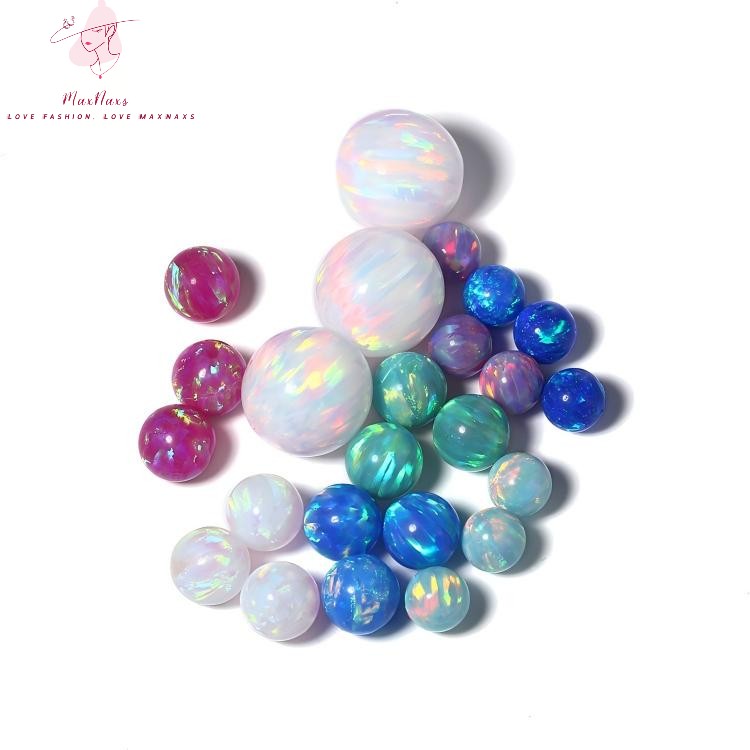
Synthetic Black Opal (OP11 / OP03 Series): Searching for black opal synthetic or lab grown black opal has grown rapidly among men's jewelry, gothic, and luxury demi-fine brands. The dark body tone dramatically amplifies neon green, red, and electric blue fire flashes.
-
Lab Created Blue Opal (OP17 / OP26 Series): Offering vibrant ocean and Caribbean hues, lab created blue opal is a top seller for summer resort collections, coastal jewelry brands, and sterling silver inlay lines.
B. Full Spectrum of Supply Forms
Whether you operate a lapidary studio or a retail jewelry brand, the best manufacturer should supply multiple formats:
-
Synthetic Opal Rough & Blocks: Uncut synthetic opal rough slabs and raw synthetic opal material for custom carving, crushed opal ring inlays, and watch dials.
-
Calibrated Loose Synthetic Opal Stone: Precision-cut cabochons, faceted stones, baguettes, and custom shapes ready for prong or bezel setting.
-
Synthetic Opal Beads: Center-drilled, half-drilled, and rondelle synthetic opal beads for beaded bracelets,station necklaces, and drop earrings.
3. Why MaxNax Jewellery Is the Best Lab Opal Stone Manufacturer in China
When evaluating suppliers on stone brilliance, cutting precision, and full-scale jewelry production, MaxNax Jewellery stands out as China’s leading B2B partner. Located in the heart of China’s jewelry manufacturing hub, we bridge the gap between advanced lapidary cutting and fine metal craftsmanship.
Here is why global brands trust MaxNax Jewellery when looking for synthetic opal for sale and custom OEM production:
1. Authentic 80% Silica Lab Made Opal Quality
We strictly reject cheap plastic imitations. Every synthetic opal stone we cut is crafted from high-density silica-polymeric rough. Whether you order lab grown black opal, classic white fire, or lab created blue opal, we guarantee 98%+ batch-to-batch color consistency across 60+ standardized color codes.
2. Precision Lapidary: Loose Stones, Beads & Custom Cuts
From $1.0\text{mm}$ micro-melee stones to complex geometric inlay pieces and smooth synthetic opal beads, our lapidary specialists maintain tight $\pm 0.05\text{mm}$ tolerances. Need a proprietary brand shape, star/moon fantasy cut, or faceted lab created opal? We cut directly from synthetic opal rough to match your exact 3D CAD specifications.
3. One-Stop S925 Silver & Gold Vermeil Jewelry OEM/ODM
Buying loose stones from one vendor and hiring another factory for metal casting leads to high stone-breakage rates and delays. MaxNax Jewellery provides seamless end-to-end production:
-
Precious Metals: Certified S925 Sterling Silver, Solid Gold, and high-grade Brass.
-
Superior Plating: Long-lasting 14K/18K Gold Vermeil and PVD coating with anti-tarnish protection.
-
Multi-Stone Pairing: Combining lab created opals with Moissanite, Lab-Grown Diamonds, and 5A Cubic Zirconia.
4. Your Project Checklist: Requesting an OEM/ODM Quote (RFQ)
To help our engineering team provide an accurate quotation for your lab opal jewelry or loose stone order, please prepare the following project essentials:
| Project Category | Required Details |
|
Design reference |
Sketch, image, CAD drawing or an existing sample |
|
Product details |
Type, dimensions, materials, stones (e.g., synthetic black opal, synthetic opal beads) and surface finish |
|
Estimated quantity |
Pieces per style, number of styles and potential repeat volume |
|
Branding needs |
Logo engraving, tags, pouches, boxes or retail presentation |
|
Buying market |
Destination country, compliance needs and preferred delivery window |
(Note: MOQ, sample costs, production timing and any testing requirements are confirmed for each individual project.)
👉 Ready to source factory-direct lab opals or launch your custom jewelry line? Contact MaxNax Jewellery Today to request our 60+ Color Chart and free project consultation.
5. Frequently Asked Questions (FAQ)
Q1: Is there a difference between synthetic opal, lab created opal, and lab grown opal?
In the B2B jewelry industry, synthetic opal, lab created opal, lab grown opal, man made opal, and lab made opal are used interchangeably by buyers to describe opals cultured in a laboratory setting using silica spheres. However, always confirm with your supplier that the stone contains ~80%+ silica (like gilson opal standards) rather than pure plastic artificial opal.
Q2: Do you offer raw synthetic opal material and synthetic opal rough for sale?
Yes. In addition to finished OEM jewelry and calibrated synthetic opal stone cuts, MaxNax Jewellery supplies synthetic opal rough blocks, crushed opal, raw synthetic opal material, and drilled synthetic opal beads for wholesale buyers and custom jewelry workshops.
Q3: Why is synthetic black opal so popular for custom jewelry?
Synthetic black opal (or black opal synthetic) features a deep dark body tone that makes rainbow color flashes look significantly brighter and more vivid than white opals. Because natural Australian black opals cost thousands of dollars per carat, lab grown black opal allows brands to offer that same luxury aesthetic at an accessible retail price point.
Q4: Will lab created blue opal or white opal fade in water?
No. Unlike natural hydrophane opals that absorb water and crack, our silica-resin lab created opals are non-porous and waterproof. They maintain their fire and structural integrity during daily wear and handwashing.